Mining for key energy-transition minerals is not a major source of global greenhouse gas emissions, ICMM research finds
New global dataset puts mining and metals emissions in perspective as demand for energy transition minerals grows
LONDON, March 10, 2026 /PRNewswire/ -- Today, ICMM publishes its new Global Mining & Metals Greenhouse Gas (GHG) Emissions Dataset, alongside an insights report that provides the most comprehensive, up-to-date picture of how the mining and metals sector scope 1 and scope 2 emissions contribute to global GHG emissions[1].
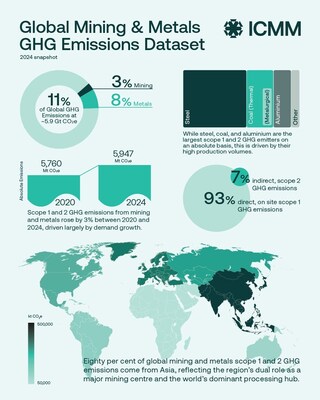
Key findings:
- Mining for minerals important for the green energy transition and sustainable development is not a major source of GHG emissions.
- Non-coal mining represented just 0.54% of global GHG emissions in 2024.
- By comparison, fugitive emissions from coal, which must be phased out to meet global climate goals, accounts for 2.46% of global GHG emissions. - In total, scope 1 and 2 emissions from mining (3%) and metal processing (8%) in 2024, position the sector as the sixth largest source of global GHG emissions, contributing less than the power generation, transport and agriculture sectors and about as much as all other industrial processing activities.
- Steel and aluminium production, along with coal mining, were the largest sources of GHG emissions overall, together responsible for 93 per cent of sector scope 1 and 2 emissions in 2024.
- Demand for steel and aluminium, which are important for infrastructure underpinning the green transition, is forecast to increase in the coming years
- Decarbonising steelmaking and aluminium smelting represent the most significant opportunities for sector-level decarbonisation - Approximately 80% of the sector's global scope 1 and 2 emissions originate in Asia, reflecting both the concentration of primary mines and processing facilities for most global commodities in the region.
By combining facility-level data from 1,700 facilities across 14 commodities representing 87% of global production, and modelling emissions using regional commodity-level averages for the remaining (13%) production volume, the dataset captures an industry-wide total of scope 1 and 2 emissions in 2024. The dataset is designed for high–level sector and regional insights only and is not suitable for benchmarking companies or assets, or for assessing corporate progress against targets. In contrast to corporate-level data, this dataset offers an industry-wide picture, explores regional and commodity-specific emissions profiles and allows comparison of mining and metals GHG emissions with emissions from other major industries. The findings offer important context at a time when demand for minerals and metals is rising rapidly to support the global energy transition and the infrastructure and urbanisation needs of a growing population.
As the world progresses towards the goal of tripling renewable energy capacity by 2030, demand for minerals and metals is projected to grow significantly, reflecting the sector's essential role in building clean technologies. At the same time, producing these materials is energy-intensive, which means the mining and metals industry is both a contributor to GHG emissions and a key enabler of the energy transition. By publishing this dataset – the second in a planned series of data-backed reports - ICMM's intention is to strengthen our collective understanding of the mining and metals sector's contribution to GHG emissions and support informed decision-making for policymakers, investors and all relevant stakeholders.
Dr Emma Gagen, Director of Data and Research, ICMM: "Despite our sector's importance to the energy transition, up-to-date, publicly available and industry-wide data has been lacking, contributing to the circulation of misleading estimates. ICMM's Global Mining & Metals GHG Emissions Dataset provides data and data-driven insights to underpin more informed dialogue about the sector's contribution to global GHG emissions while providing the building blocks for sustainable development and the global energy transition.
"Like all large-scale datasets, this one will evolve, but establishing a transparent, industry-wide baseline is a necessary starting point. Inferred implications from the Dataset are provided separately from the data itself to allow others to be curious and make their own judgements. We invite all interested stakeholders to engage with the data, provide feedback or supplementary data to help improve its coverage, and collaborate with us further."
Notes to editors
Like all large-scale datasets, the data has limitations based on boundaries we have set for quality control and will evolve through further collaborations. Certain refining stages (e.g., gold, silver, cobalt, platinum group metals, lead) and some gases (e.g., hydrofluorocarbons, SF₆) are excluded due to data limitations. See the Limitations section of our report for further information.
This Dataset and report are part of ICMM's wider Global Mining Data Project that aims to significantly improve the quality and accessibility of industry-wide information by building robust, transparent data that can inform policy and advance wider discussions about mining and metals' evolving role in sustainable development.
Methodology
To prepare the dataset we partnered with Wood Mackenzie who used a proprietary method aligned with the GHG Protocol to calculate facility-level emissions for approximately 1,700 facilities that they have sufficient information on and to model the emissions from the production gap not covered by facility-level information. For the facility-level emissions, data was not aggregated from public sources; it was calculated so as to ensure a consistent method across the dataset. This facility-level modelling approach is distinct from corporate GHG inventories prepared by individual mining companies under the GHG Protocol, which are compiled at the organisational level based on operational control and materiality, and for scope 2 emissions, typically determined using both location-based and market-based methods.
Wood Mackenzie calculated the coverage of their facility-level data by comparing production volumes from these facilities with global production volumes for each of the 14 commodities that are included in our analysis. Facility–level modelling covers ~87% of production for the 14 commodities; the remaining ~13% was approximated using regional commodity averages. Facility-level data will not be made public in the dataset or the report, as it is Wood Mackenzie's proprietary data. However, it was used to allow us to estimate scope 1 and 2 emissions for the missing global production volume that was not covered with their facility-level calculations.
Please see the Methodology section of the Report for further details.
About ICMM
ICMM stands for mining with principles. We bring together a third of the global metals and mining industry, along with key partners to drive leadership, action and innovation for sustainable development, ultimately delivering a positive contribution to society. Through collaboration, ICMM member companies set the standard for responsibly produced minerals and metals in a safe, just and sustainable world.
[1] The dataset is a modelled, sector–level estimate, not an aggregation of company–reported inventories. It is not intended to infer corporate progress towards decarbonisation targets, or asset level performance.
Photo - https://mma.prnewswire.com/media/2927456/ICMM.jpg
 View original content:https://www.prnewswire.co.uk/news-releases/mining-for-key-energy-transition-minerals-is-not-a-major-source-of-global-greenhouse-gas-emissions-icmm-research-finds-302709285.html